By Pleun Rietveld on 28 Aug 2026, 17:26:02

Good LED work lights provide better visibility when working in the dark. But what if the radio starts crackling as soon as you turn on the lights? Or if the GPS reception, onboard computer, camera, or other electronic equipment starts malfunctioning?
The cause usually isn’t the LEDs themselves, but the electronics inside the light. These can cause electromagnetic interference. With modern trucks, agricultural machinery, and construction equipment featuring increasingly sensitive electronics, it’s therefore important to consider more than just light output and price.
Electromagnetic compatibility—EMC for short—also deserves attention. A high-quality, properly tested work light reduces the likelihood that the lighting will interfere with other equipment in or around the vehicle.
Why can LED work lights cause interference?
An LED work light does not operate directly on the vehicle’s voltage. The light contains an electronic control unit that converts and regulates the supplied voltage so that the LEDs can burn steadily.
This electronics switches very quickly. This can generate unwanted electromagnetic signals. If those signals fall within a frequency range also used by other equipment, interference can occur.
This can happen in two ways:
- Through electromagnetic radiation emitted by the lamp or wiring.
- Through the vehicle’s electrical system and power cables.
In this case, the wiring can act as a kind of antenna. The quality of the lamp and the way it is connected therefore jointly influence the final result.
What devices can be disrupted by LED lighting?
Radio interference is often the first and most obvious sign. However, the consequences can go beyond just some static while listening to music or the news.
Electromagnetic interference may affect:
- FM, DAB+, and communication radios.
- GPS and GNSS receivers.
- RTK positioning on agricultural and earth-moving machinery.
- Onboard computers and telematics systems.
- Camera and monitor systems.
- Bluetooth and Wi-Fi connections.
- Mobile communications.
- Sensors and vehicle control systems.
- Other electronic devices in or on the vehicle.
Which devices are actually affected depends on the frequencies, distance, shielding, cabling, and sensitivity of the system.
Why can EMC interference have serious consequences?
A crackling radio is annoying, but usually not immediately dangerous. If navigation, machine control, or precise positioning systems are disrupted, the operational consequences can be much more severe.
Consider, for example, an excavator that uses GPS or RTK positioning. If the positioning becomes inaccurate or is temporarily interrupted, the operator can no longer fully rely on the displayed location or digging depth.
This can lead to:
- Inaccurately performed work.
- Damage to cables, pipes, or infrastructure.
- Delays in the project.
- Additional repair costs.
- Unnecessary downtime.
- An unsafe work environment.
- Disputes over the cause or responsibility.
Even with transport vehicles, failures in communication, cameras, or telematics can disrupt operations. As a result, a cheap work light can ultimately incur much higher costs than the price difference compared to a higher-quality solution.
What does EMC mean?
EMC stands for electromagnetic compatibility. It means that electrical and electronic equipment must be able to function in the same environment without causing unacceptable interference with one another.
EMC considers two properties:
Electromagnetic emissions
This is the electromagnetic interference that a device itself generates and emits. In the case of an LED work light, for example, this involves signals from the internal electronics or wiring.
Electromagnetic immunity
This is the degree to which equipment can withstand external interference. A device must continue to function when other systems in the environment generate electromagnetic signals.
A good work light therefore produces as little unwanted emission as possible while also being sufficiently resistant to interference from the vehicle’s electrical system.
Which EMC standard is important for LED work lights?
For lighting used in vehicles and mobile machinery, CISPR 25 is often referenced. This international standard describes measurement methods and limit values for radio interference that can be caused by electrical components in vehicles.
The standard is intended to protect receivers in the vehicle, including:
- Radio.
- Mobile communications.
- GPS and other satellite navigation systems.
- Wi-Fi.
- Bluetooth.
- Vehicle communication.
CISPR 25 uses various emission classes. A higher class imposes stricter requirements on the amount of electromagnetic interference a component is allowed to generate.
CISPR 25 Class 5 is considered the strictest class.
A label such as “EMC-approved” is not always sufficient on its own. Therefore, ask which standard, model, and classification actually apply to the work light.
Does an EMC certification mean that interference is impossible?
No. An appropriate EMC classification significantly reduces the risk, but does not provide an absolute guarantee that interference will never occur in every vehicle configuration.
This is because the entire installation also plays a role. Consider:
- The quality and routing of the wiring.
- The lamp’s location relative to antennas.
- The quality of plugs and connectors.
- A proper ground connection.
- The power supply, relays, and switches used.
- The number of lamps installed.
- The sensitivity of the equipment present.
- Subsequent modifications to the vehicle.
- Damaged or poorly shielded cables.
A light may perform well under standardized test conditions, but improper installation can still cause problems. That is why both product selection and professional installation are important.
How can you identify interference caused by LED work lights?
EMC interference can often be identified by the fact that a problem begins immediately when the work lights are turned on and disappears again when they are turned off.
Possible signs include:
- The radio starts to crackle or loses reception.
- DAB+ radio temporarily cuts out.
- GPS reception becomes weaker or unstable.
- The displayed vehicle or machine position fluctuates.
- A camera displays streaks, static, or an unstable image.
- Wireless connections drop out.
- Communication devices have reduced range.
- Electronic devices display an error message.
- The problem gets worse when multiple lights are on.
Also note the difference between various lighting settings. If the interference occurs only when dimming or with a single specific light, this can help pinpoint the cause.
Here’s how to check if the work light is the cause
Do you suspect that an LED work light is causing a malfunction? If so, you can systematically check for the problem.
1. Turn on the lights one at a time
Turn on the work lights one by one. Check which light or combination of lights triggers the malfunction.
2. Compare the situation with the lights turned off
Does the malfunction disappear immediately when the lights are turned off? If so, the issue is likely related to the light, power supply, or wiring.
3. Check other equipment
Test not only the radio, but also the GPS, cameras, onboard computer, and any communication systems.
4. Check connections and ground
A poor ground connection or damaged cable can increase the likelihood of a malfunction.
5. Check the product specifications
Look for a specific EMC standard and classification. The “CE” or “EMC” marking alone does not provide sufficient information about performance in a vehicle.
6. Have the installation assessed
If the cause is unclear, a specialist can inspect the lights, wiring, power supply, and position relative to antennas.
Can existing EMC interference be resolved?
That depends on the cause. Sometimes the interference can be reduced by modifying the installation. In other cases, the work lights must be replaced.
Possible measures include:
- Establishing a better ground connection.
- Rerouting the cabling.
- Separating power and signal cables from each other.
- Avoid making cables unnecessarily long.
- Replace defective connectors.
- Place the lamp farther away from antennas or receivers.
- Apply appropriate shielding or filtering.
- Rebuild the electrical connection.
- Replace the problematic lamp with a more thoroughly tested model.
A standalone interference filter isn’t automatically the best solution. It’s important to first determine exactly where the interference is originating. Otherwise, you may only be treating the symptom.
What should you look for when buying LED work lights?
Light output is important, but it is only one aspect of a good work light. When selecting a work light, also check:
- The specific EMC standard and class.
- The actual light output in lumens.
- The light pattern: flood, wide flood, spot, or high beam.
- The color temperature.
- The supply voltage.
- The power consumption.
- The protection rating against water and dust.
- Resistance to vibrations and shocks.
- Operating temperature.
- The quality of the housing and lens.
- The connector used.
- Suitability for the vehicle and application.
- Availability of technical documentation.
- Warranty, service, and support.
A very high theoretical light output does not automatically mean that a lamp will perform better in practice. It is best to look at the operational light output and the distribution of light at the worksite.
Inexpensive or professional LED work lights?
Inexpensive LED work lights may seem attractive when equipping multiple vehicles or machines. However, the price difference often stems from variations in electronics, sealing, cooling, materials used, EMC performance, and quality control.
A professional work light generally offers greater reliability in terms of:
- Stable light output.
- Uniform light distribution.
- Electromagnetic compatibility.
- Water and dust resistance.
- Vibration resistance.
- Heat dissipation.
- Service life.
- Technical documentation.
- Service and parts.
The best choice isn’t necessarily the most expensive lamp. The work light must be compatible with the vehicle, the work being done, and the vehicle’s electronics.
What work lights does Rietveld use?
Rietveld supplies a variety of professional LED work lights for transportation, construction, agriculture, waste collection, and other heavy-duty applications.
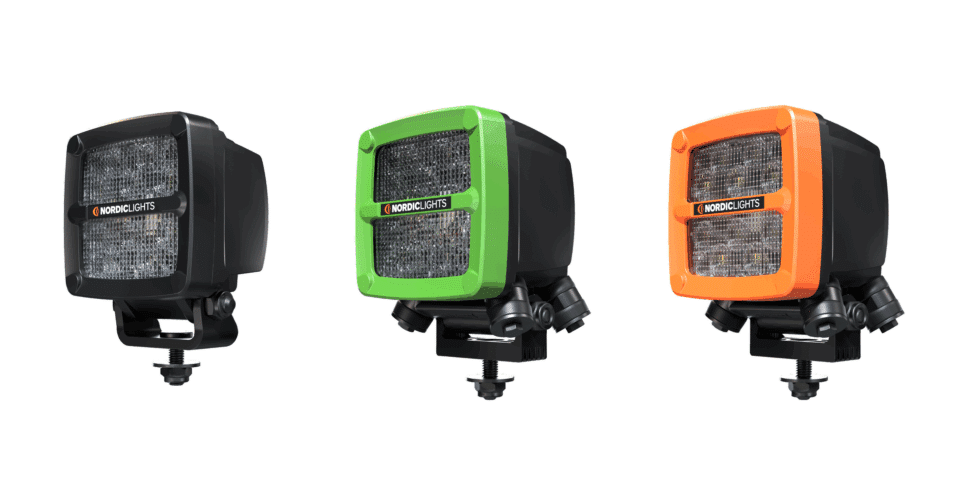
For intensive and heavy-duty use, Rietveld supplies work lights from Nordic Lights, among others. Depending on the model, these have been tested in accordance with CISPR 25 Class 5 and additional standards for specific vehicle and machinery categories.
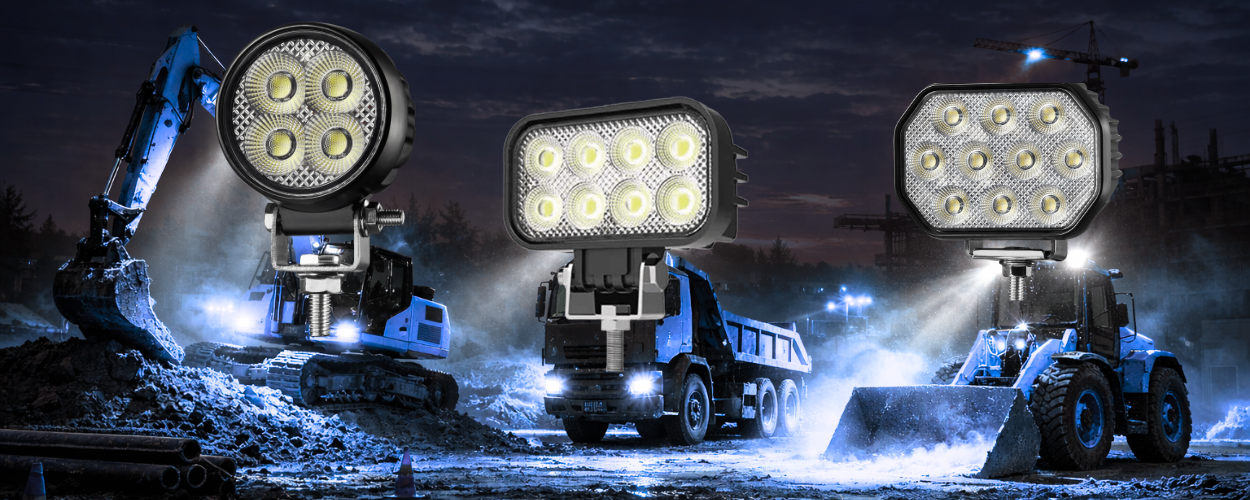
In addition, Rietveld offers various other brands and models, including solutions from Lumer and ECCO. This allows us to determine the right combination of the following for each vehicle and application:
- Light output.
- Light pattern.
- EMC performance.
- Durability.
- Dimensions.
- Mounting position.
- Price and frequency of use.
Not every light is suitable for every situation. A compact work light for a pickup truck requires different features than lighting on an excavator, garbage truck, or agricultural vehicle.
The right light pattern for every application
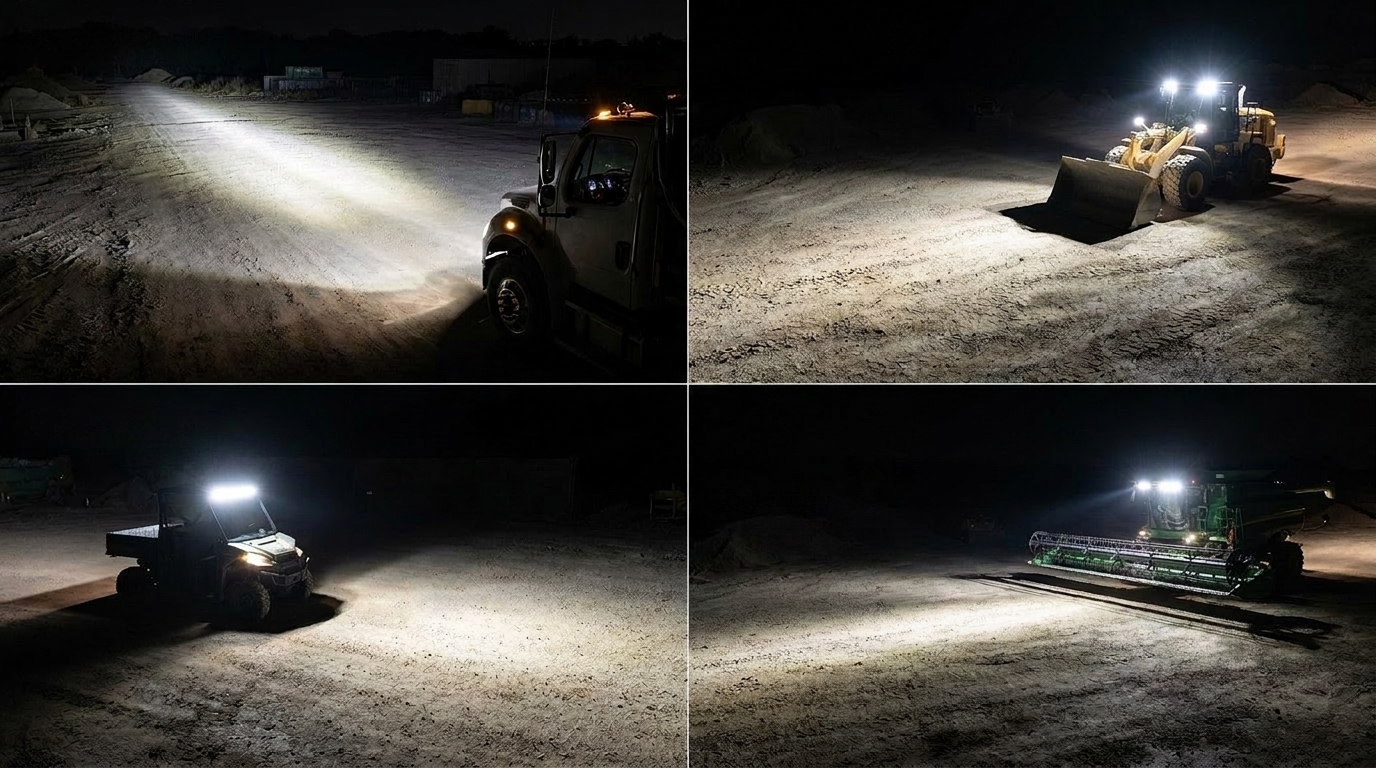
In addition to EMC, the light pattern is also important. An incorrectly chosen lamp may produce a lot of light but still fail to provide adequate visibility where it’s needed.
Flood
A flood light pattern spreads the light over a wide work area. This is suitable for general lighting near the vehicle or machine.
Wide flood
An extra-wide light pattern illuminates a large area around the vehicle. This can be useful when maneuvering, loading, unloading, or working with machinery.
Spot or high beam
A focused beam reaches farther ahead. This configuration is suitable for situations where visibility at a greater distance is required.
Often, a combination of different light patterns yields the best results. Rietveld takes into account the specific tasks, mounting height, and desired visibility zones.
Why professional installation is important
Even a high-quality, EMC-tested work light may not perform as well if it is connected or mounted incorrectly.
During professional installation, attention is paid to, among other things:
- The correct mounting position.
- A secure and vibration-resistant mounting.
- The required light distribution.
- Protection of cables.
- Waterproof connectors and feed-throughs.
- A reliable ground connection.
- Appropriate fuses, relays, and switches.
- The load on the electrical system.
- Distance from antennas and sensitive equipment.
- Prevention of glare and annoying stray light.
- Checking for malfunctions after installation.
After installation, the lights are tested in conjunction with the vehicle’s radio, cameras, navigation system, and other relevant equipment.
Maintenance of LED work lights
LED work lights require relatively little maintenance, but regular inspections help prevent failures, reduced light output, and electrical problems.
Check periodically:
- Whether the lens is clean and undamaged.
- Whether the light is still securely mounted.
- Whether the beam angle has changed.
- Whether the cables and connectors are intact.
- Whether there is moisture inside the housing.
- Whether the light output remains uniform.
- Check whether the light is flickering or operating irregularly.
- Whether the radio, GPS, and other electronics continue to operate without interference.
- Whether the housing can dissipate sufficient heat.
Have the system inspected if a malfunction occurs suddenly, especially if the lights were previously functioning without issues. Damage, corrosion, or a poor connection can affect the EMC performance of the entire system.
Have LED work lights recommended and installed by Rietveld
A suitable work light must provide sufficient light, withstand the work environment, and be compatible with the vehicle’s electronics.
Rietveld therefore considers, among other things:
- The type of vehicle or machine.
- The nature of the work.
- The desired viewing distance and light distribution.
- The mounting height and available space.
- The radio, GPS, and camera systems present.
- The required EMC classification.
- The supply voltage and electrical load.
- Water, dust, vibrations, and temperature.
- The desired service life.
- The available budget.
We then advise you on the brand, type, light pattern, and proper mounting position. Our technicians handle the installation, wiring, adjustment, and inspection.
This way, you’re not just investing in more light, but in a reliable lighting solution tailored to your vehicle and your work.
Prevent interference from your work lights
Does your radio start to crackle when you turn on the LED work lights? Or do you want to prevent new lighting from interfering with GPS, cameras, or other electronic equipment before it’s too late?
Have Rietveld assess your current situation or ask for advice before having new work lights installed. We’ll help you choose a suitable, robust, and EMC-tested solution.

When Should You Choose Nordic Lights Heavy-Duty Work Lights? | Rietveld
LUMER LED Work Lights: Quality at a Competitive Price