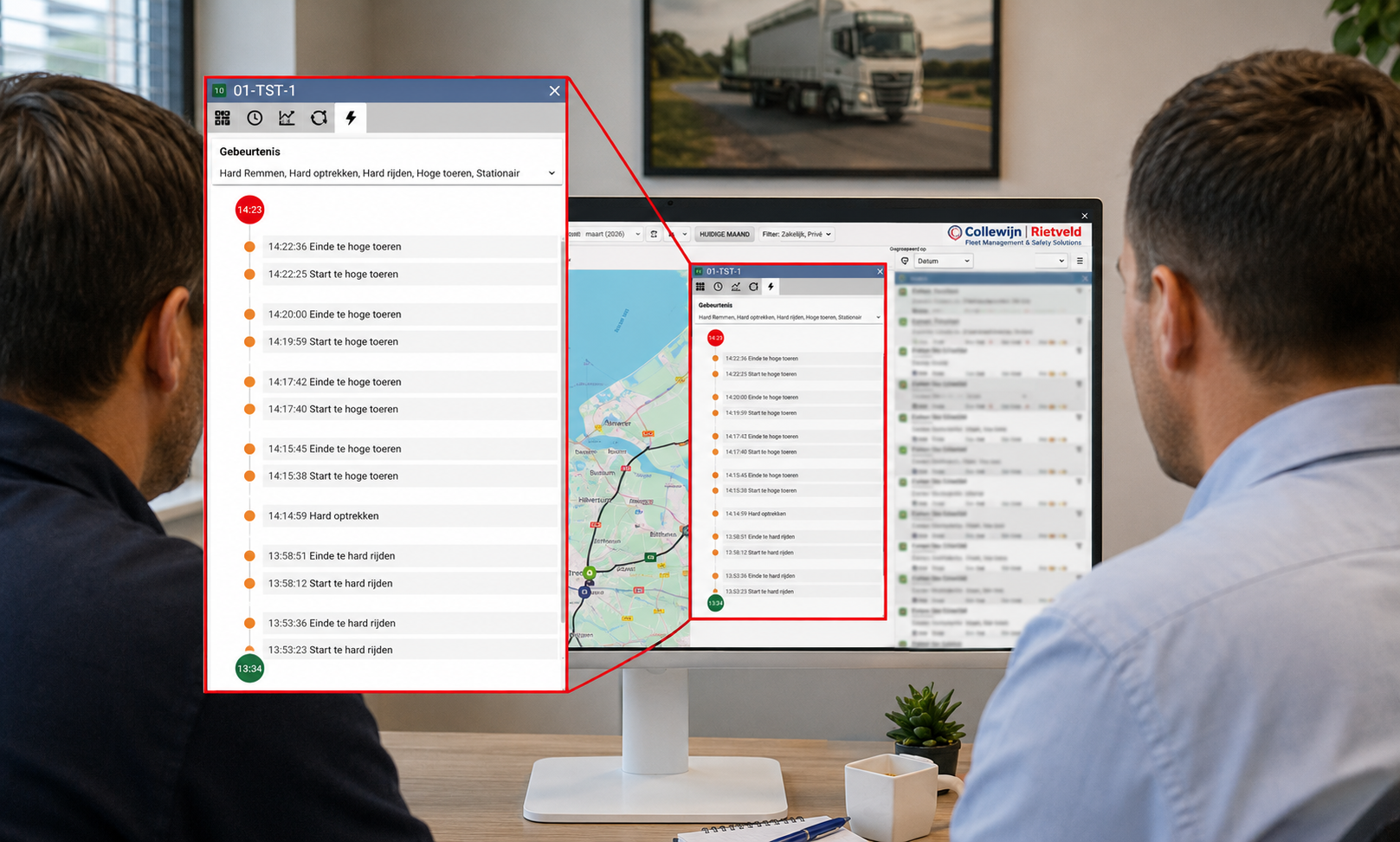
Driving and Rest Times 2026: Rules and Tachograph Requirements | Rietveld
By Jörgen Visser on 31 Aug 2026, 09:26:04
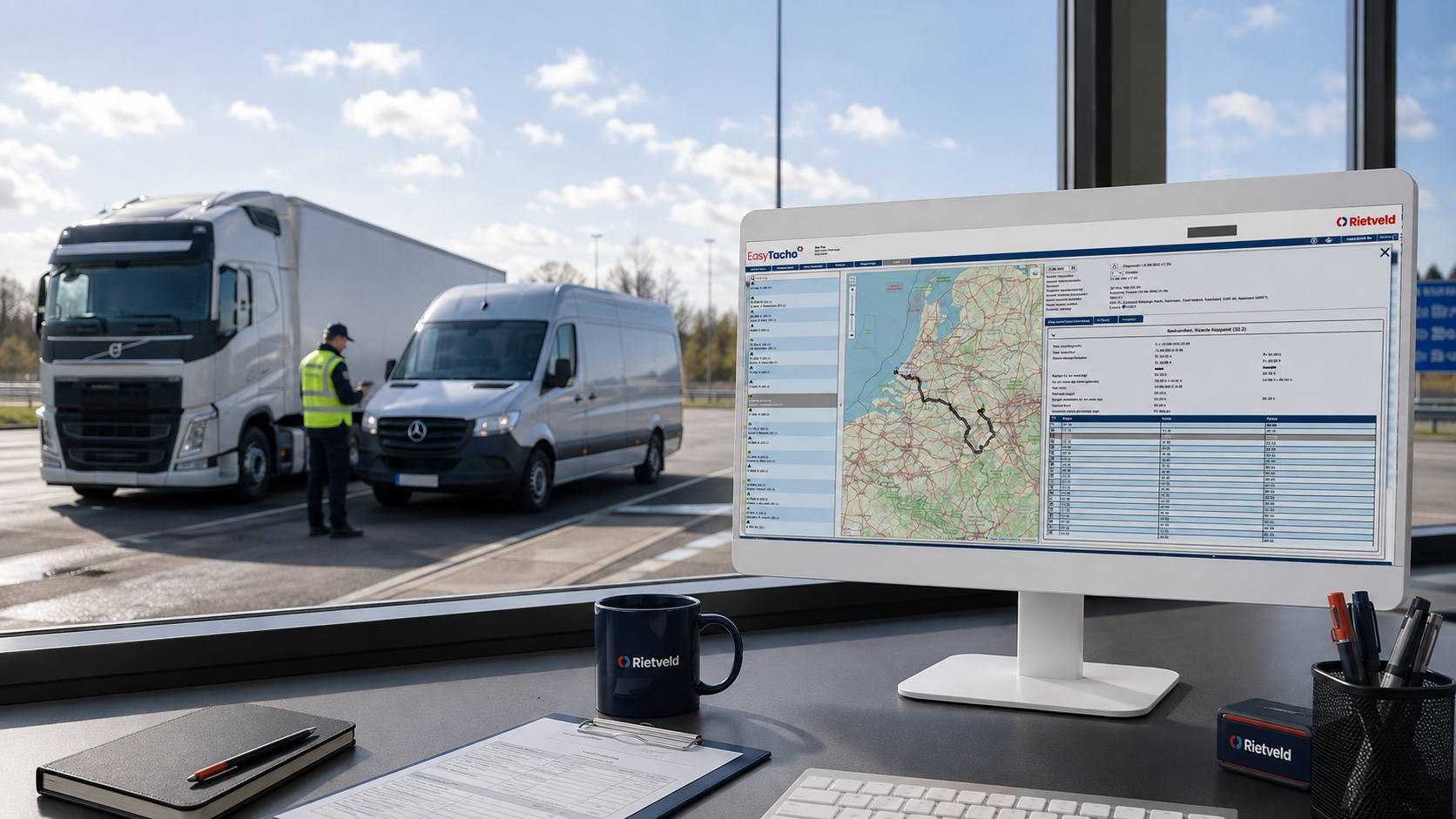
Since July 1, the rules also apply to certain delivery vans
Carriers must be able to demonstrate that drivers comply with European driving and rest time regulations. To this end, the tachograph records, among other things, driving time, other work activities, availability, breaks, and rest periods.
As of July 1, 2026, this requirement no longer applies exclusively to trucks and buses. Light commercial vehicles with a maximum authorized mass exceeding 2,500 kilograms are also subject to European driving and rest time regulations when used for international freight transport or cabotage.
In principle, these vehicles must then be equipped with the second-generation smart tachograph: Smart Tacho 2.
This affects more than just transportation companies. Couriers, delivery services, service organizations, construction companies, and other businesses that transport goods across borders using delivery vans must also assess whether their vehicles and operations fall under the new requirement.
Status of the legislation: July 2026.
Why are driving and rest periods in place?
European driving and rest periods are established to:
- prevent fatigue while driving;
- improve traffic safety;
- provide drivers with good working conditions;
- promote fair competition in the road transport sector;
- prevent structurally excessive workdays.
The rules apply to employees and self-employed drivers, as well as to transport for their own account and for the account of third parties, unless a specific exemption applies.
It is the driver’s responsibility to operate the tachograph correctly. The transportation company must organize work in a way that ensures compliance and must retain, review, and, where necessary, follow up on the recorded data.
For which vehicles does the tachograph requirement apply?
The European driving and rest time regulations and tachograph requirement generally apply to:
- vehicles and vehicle combinations used for freight transport with a maximum authorized mass exceeding 3,500 kilograms;
- passenger vehicles designed to carry more than nine people, including the driver;
- as of July 1, 2026: light commercial vehicles and vehicle combinations weighing more than 2,500 kilograms that engage in international freight transport or cabotage.
The weight taken into account is the maximum authorized mass of the entire combination. A delivery van may weigh less than 2,500 kilograms on its own, but could still exceed the limit due to a trailer.
New Rules for Delivery Vans Effective July 1, 2026
The expansion to light commercial vehicles is particularly relevant for vans with a maximum authorized mass of more than 2,500 kilograms up to and including 3,500 kilograms.
The new requirement applies when the vehicle is used for:
- is used for international freight transport;
- is driven in another EU member state;
- cabotage transport is carried out;
- the 2,500-kilogram limit is exceeded, possibly with a trailer or semi-trailer.
As of July 1, 2026, these delivery vans will be subject to the same European driving and rest time regulations as heavier trucks. They must also be equipped with a Smart Tacho 2.
Does this also apply to domestic transport?
A delivery van weighing between 2,500 and 3,500 kilograms that operates exclusively within the Netherlands is not automatically subject to the tachograph requirement under this new European expansion. The expansion effective July 1, 2026, applies to international freight transport and cabotage.
If the maximum authorized mass of the vehicle or combination exceeds 3,500 kilograms, the standard tachograph requirement may apply.
The exact assessment depends on the vehicle, the combination, the nature of the work, and any exemptions.
Exemptions: Not every delivery van is subject to the tachograph requirement
There are international and national exemptions. For example, under certain conditions, an exemption may apply to vehicles or combinations weighing up to 7,500 kilograms that a driver uses to transport materials, tools, or machinery necessary for his or her own profession.
Conditions apply, such as:
- the vehicle remains within a 100-kilometer radius of the place of business;
- driving is not the driver’s primary activity;
- according to the Dutch ILT standard, the vehicle is driven for no more than 12 hours per week.
For vehicles weighing between 2,500 and 3,500 kilograms, there is also an international exemption when goods are transported for the driver’s own account and driving is not the driver’s primary activity. In such cases, the transport may not be carried out on behalf of third parties.
Exemptions also apply to, among others, emergency services, certain agricultural activities, repair and recovery vehicles, and some specific government tasks.
In most cases, you do not need to apply for an exemption in advance. However, during an inspection, you must be able to demonstrate that you meet all the conditions. Therefore, always have your specific situation assessed and keep accurate records.
The most important driving times at a glance
For drivers subject to Regulation 561/2006, the following limits apply, among others:
Daily driving time
A driver may normally drive a maximum of nine hours per day. Twice a week, this may be extended to ten hours.
Weekly driving time
The maximum driving time is 56 hours per week.
Driving time over two consecutive weeks
Over two consecutive weeks, a driver may drive a maximum of 90 hours. This limit is cumulative: not only do weeks one and two count together, but so do weeks two and three.
Uninterrupted driving time
After driving for a maximum of 4.5 hours, the driver must take a break of at least 45 minutes.
This break may be split into:
- first, at least 15 minutes;
- followed by at least 30 minutes.
The order is mandatory. Two breaks of 30 and 15 minutes do not comply with this split-break rule.
Other activities also count
Driving time is not the same as working time. Loading and unloading, cleaning, maintenance, administrative tasks, and other activities may also count as working time.
The following rules, among others, apply to working time:
- for a workday between six and nine hours: a minimum 30-minute break;
- for a workday longer than nine hours: a minimum 45-minute break;
- never work for more than six consecutive hours without a break.
A driver must therefore not only insert the driver card but also select the correct activity. Examples include driving, other tasks, availability, break, or rest.
Selecting the wrong activity can later lead to an incorrect assessment of driving and rest times, as well as errors when the same data is used for time tracking.
Daily and Weekly Rest
The standard daily rest period is at least eleven consecutive hours.
This rest period may:
- be shortened to nine hours no more than three times between two weekly rest periods;
- be split into an initial period of at least three hours followed by a period of at least nine hours.
A normal weekly rest period lasts at least 45 consecutive hours. Under certain conditions, this may be reduced to a minimum of 24 hours. The missed rest must be compensated for later in accordance with European regulations.
A normal or compensated weekly rest period may not be spent in the cab. The employer must provide suitable accommodations with appropriate sleeping and sanitary facilities and cover the associated costs.
In addition, the transportation company must organize work so that a driver can return to his or her place of residence or the company’s usual place of business at least once every four weeks.
What is Smart Tacho 2?
Smart Tacho 2 is the second-generation smart tachograph. For new vehicles subject to tachograph requirements, this type has been mandatory since August 21, 2023.
For heavy-duty vehicles engaged in international transport, the European transition periods have now expired. As of August 2025, all heavy-duty vehicles operating in a Member State other than their country of registration must be equipped with Smart Tacho 2.
Starting July 1, 2026, this requirement also applies to light commercial vehicles weighing more than 2,500 kilograms that are subject to tachograph requirements and are used in international freight transport.
Smart Tacho 2 records, among other things:
- driving, working, availability, and rest times;
- locations and border crossings;
- loading and unloading activities;
- use of the driver card;
- vehicle and tachograph data;
- indications of malfunctions or possible tampering.
The tachograph also features DSRC technology. This allows enforcement authorities to remotely receive certain technical data and more effectively determine which vehicles to inspect on the road.
Simply installing a tachograph is not enough
A Smart Tacho 2 helps record activities, but it does not automatically make your organization compliant.
To ensure compliance, the processes surrounding the tachograph must also be properly organized:
- drivers must enter the correct data;
- driver cards must be read in a timely manner;
- the tachograph’s mass memory must be downloaded in a timely manner;
- data must be securely archived;
- violations and discrepancies must be assessed;
- Drivers must receive feedback and instruction;
- planners must take the remaining driving time allowance into account.
When this is done manually, it takes a lot of time. Vehicles and drivers must be available for downloads, and the administration must monitor for missing data itself.
EasyTacho automatically reads tachograph data remotely
Rietveld’s EasyTacho automates the retrieval and management of tachograph and driver card data.
The digital tachograph and driver card are read remotely. As a result, a vehicle does not need to return to the branch specifically for this purpose, and the driver does not need to manually present his card for a download.
EasyTacho supports, among other things:
- automatic reading of driver cards;
- automatic reading of the message memory;
- storage of tachograph files in the cloud;
- standard archiving for 24 months;
- an overview of completed and scheduled downloads;
- alerts for missing or outdated data;
- reports on potential violations;
- automatic sending of reports to drivers;
- real-time insight into remaining driving time and required breaks.
EasyTacho can read the driver card according to a fixed cycle and automatically download the mass memory. This prevents legal download deadlines from being exceeded unnoticed.
Real-time driving times support scheduling
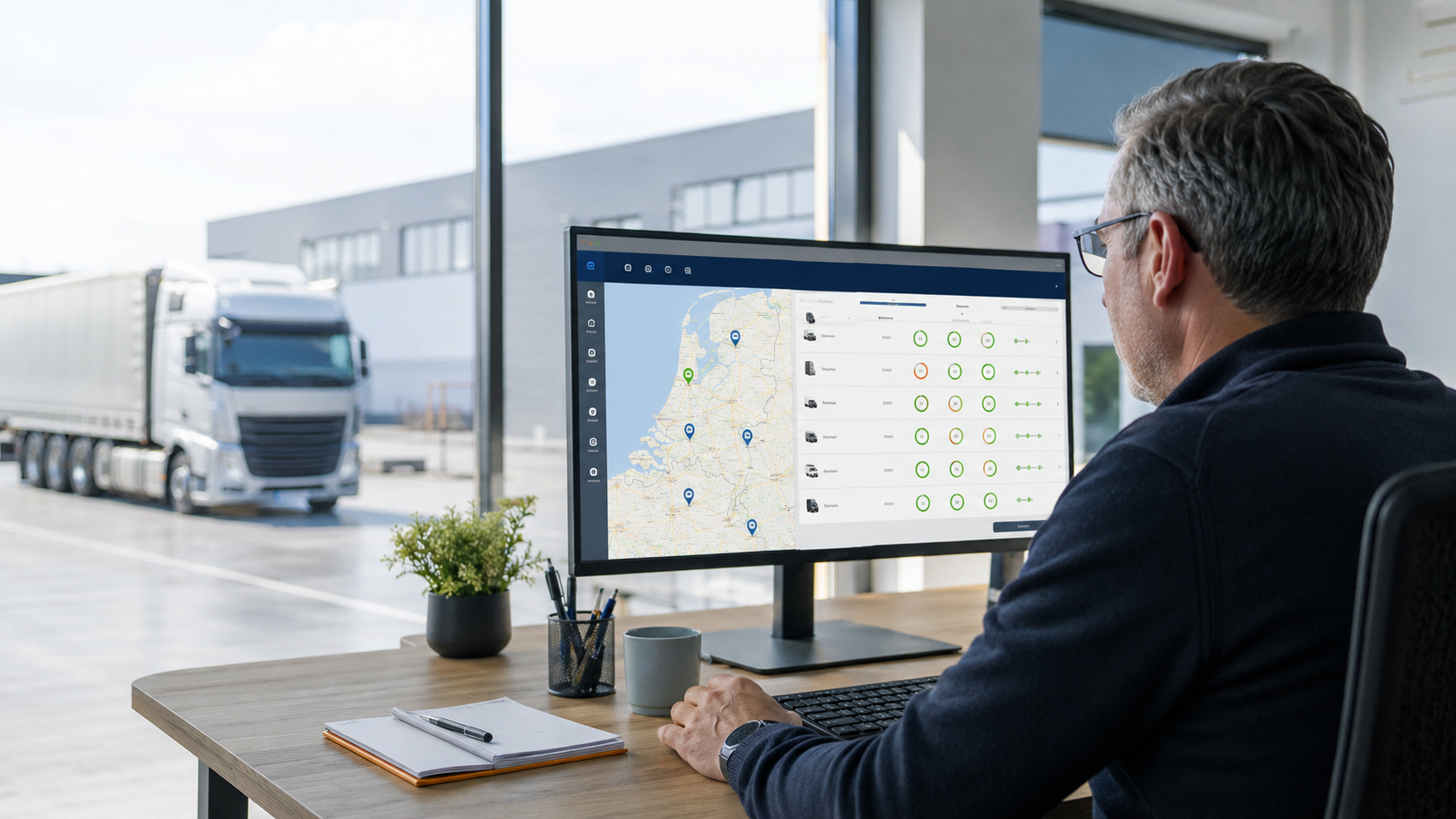
With EasyTacho Live, the scheduler can see how much driving time a driver still has available and when a break or rest period is needed.
This helps plan trips more realistically and make timely adjustments. For example, a planner can see sooner that a driver will no longer be able to reach a destination within the remaining driving time.
This offers practical benefits:
- fewer surprises along the way;
- lower risk of violations;
- more realistic arrival times;
- better distribution of trips;
- fewer phone inquiries;
- more peace of mind for the dispatcher and driver.
EasyTacho does not assume the responsibility of the driver or the carrier. However, it does provide faster access to available data, allowing for timely action.
EasyTrack connects vehicle data with operations
EasyTacho focuses on tachograph management and compliance with driving and rest periods. EasyTrack adds real-time insight into vehicles, trips, locations, stops, and deployment.
Combining both solutions provides a more complete picture:
- Where is the vehicle located?
- What route is it taking?
- What is the estimated time of arrival?
- How much driving time does the driver have left?
- When should a break be scheduled?
- Which trips and kilometers have been recorded?
- Where is a deviation from the schedule occurring?
This combination helps planners, fleet managers, and administrative staff work from a single, reliable data stream.
From tachograph data to accurate payroll
Tachograph data isn’t just relevant for monitoring driving and rest times. The recorded activities can also be used as the basis for calculating estimated hours and payroll.
Among other things, the driver records the following via the tachograph:
- driving;
- other work activities;
- availability;
- breaks and rest periods;
- loading and unloading, when this feature is used.
EasyHours can process this data in accordance with the company’s policies and collective bargaining agreement (CBA) rules. Examples include:
- working hours;
- overtime;
- contract hours;
- bonuses;
- time periods;
- lodging allowances;
- exceptions that require verification.
In this way, data that is already legally required to be recorded is also put to practical use in payroll administration.
The quality of the results depends on accurate data entry by the driver and the proper configuration of the collective bargaining agreement and company policies.
Selman Transporten: Payroll Processing Using the Smart Tachograph
Selman Transporten, based in Bemmel, has a fleet of 25 trucks, 35 drivers, and 10 office staff. The company has been a pioneer in transportation automation since 1993.
Together with Rietveld, Selman developed a solution in which the smart tachograph forms the basis for time tracking. A Qan-All vehicle server provides access to the necessary vehicle, trip, and location data. EasyHours then processes this data into a preliminary payroll calculation.
The solution is based on a clear principle: the driver is not an administrator.
The driver records his activities via the tachograph, as required by law. The data is then processed automatically. This eliminates the need for duplicate entries, and—depending on the chosen configuration—the preliminary payroll calculation can even be performed without a traditional onboard computer.
Among other things, this provides Selman with:
- less manual data entry;
- less chance of discrepancies between records;
- uniform processing for all drivers;
- greater transparency regarding hours and compensation;
- fewer disputes afterward;
- fewer devices and distractions in the cab;
- greater responsibility for accurate activity logging.
The solution was jointly developed, tested, and refined over the course of about a year. In doing so, Selman demonstrates that innovation doesn’t always mean adding more systems. Sometimes the best solution comes from using available data more intelligently.
EasyTacho, EasyTrack, and EasyHours complement each other
Each solution has its own specific function:
EasyTacho
Automates the retrieval, archiving, and analysis of tachograph and driver card data. Provides insight into driving and rest times and supports compliance.
EasyTrack
Provides real-time insight into locations, trips, routes, stops, and vehicle usage. Supports scheduling, administration, and fleet management.
EasyHours
Processes hours and activities into a preliminary payroll calculation based on configured collective bargaining agreements and company policies.
By intelligently connecting these data sources and applications, a single, cohesive process is created: from activity in the vehicle to scheduling, monitoring, and payroll processing.
The combination you need depends on your vehicles, tachographs, drivers, existing systems, and administrative processes.
What should you check now?
Especially with the expansion to light commercial vehicles, it’s wise to reassess your fleet.
Check the following for each vehicle or combination:
- What is the maximum authorized mass, including the trailer?
- Is the vehicle used for freight transport?
- Does the vehicle operate internationally or engage in cabotage?
- Does an international or national exemption apply?
- Is Smart Tacho 2 installed and properly calibrated?
- Do the drivers have a valid driver card?
- Are the driver card and message memory read out in a timely manner?
- Are violations and missing data being tracked?
- Do drivers record the correct tachograph operations?
- Can the available data also improve time and payroll processing?
Pay special attention to delivery vans that normally operate in the Netherlands but occasionally make an international trip. A single cross-border trip can mean that a vehicle weighing more than 2,500 kilograms suddenly falls under the European requirement.
Make tachograph management part of your process
Driving and rest time regulations require more than just a functioning device in the vehicle. Reliable compliance is achieved when recording, downloads, monitoring, scheduling, and payroll processing are seamlessly integrated.
With EasyTacho, EasyTrack, and EasyHours, Rietveld helps connect these processes. That means less manual work, faster insights, and greater certainty for drivers, dispatchers, and administrative staff.
Have Your Tachograph Compliance Checked
Not sure if your trucks, vans, or vehicle combinations are subject to the new regulations? Or would you like to automatically use tachograph data for scheduling and payroll processing?
Have our specialists assess your vehicles, tachographs, and processes, and get advice on EasyTacho, EasyTrack, and EasyHours.
Together, we’ll strengthen your fleet, employees, and organization with reliable data and smart automation.
Together, Skilled, Moving Forward >
You May Also Like
These Related Stories
EasyTacho Driving Times Visible in Real Time in EasyTrack | Rietveld

2026 Collective Bargaining Agreement: Automatic Payroll Processing via Tachograph | Rietveld