By Pleun Rietveld on 31 Aug 2026, 10:29:21
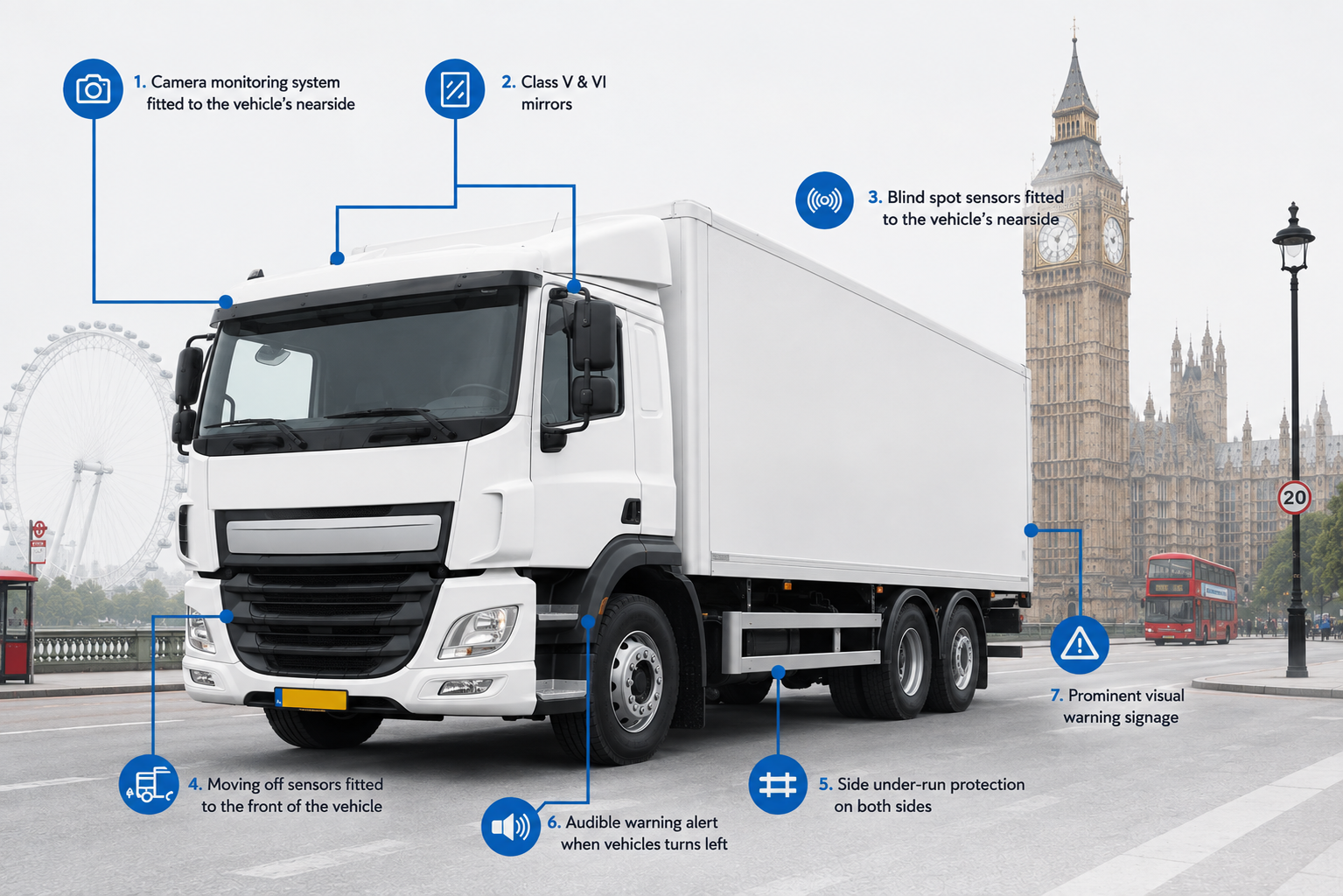
Do you drive a truck through London? If so, you’ll need to comply with the Direct Vision Standard and the HGV Safety Permit Scheme. These regulations are designed to better protect vulnerable road users, such as cyclists and pedestrians, from the risk of collisions involving heavy vehicles.
For trucks with limited direct visibility, the Progressive Safe System is required to apply for a valid safety permit. Rietveld provides a complete Camos solution for this purpose, featuring cameras, intelligent detection, and alerts.
This helps the driver recognize dangerous situations sooner and ensures the vehicle demonstrably meets the applicable safety requirements.
What is the Direct Vision Standard?
The Direct Vision Standard, or DVS for short, assesses how much a truck driver can see directly through the cab windows. This refers to direct visibility, without the use of mirrors or cameras.
Based on the vehicle’s design and the height of the cab, the manufacturer assigns the truck a rating of zero to five stars:
- 0 stars: very limited direct visibility;
- 1 or 2 stars: limited direct visibility;
- 3 to 5 stars: better direct visibility from the cab.
The star rating is tied to the vehicle’s design and cannot be increased by retrofitting cameras or sensors. However, additional safety systems may allow a vehicle with a low rating to still qualify for an HGV Safety Permit.
Which trucks are subject to DVS London?
All trucks with a gross vehicle weight exceeding 12 metric tons must have a valid HGV Safety Permit to drive in most of Greater London.
This also applies to:
- Dutch and other foreign trucks;
- vehicles that enter London only occasionally;
- tractor-trailer combinations;
- box trucks;
- concrete mixers and construction vehicles;
- vehicles that load or unload goods in London.
The regulation applies 24 hours a day, seven days a week. Even for a single trip to London, the vehicle must have a valid permit. The permit itself can be requested free of charge from Transport for London. View the current DVS rules on the Transport for London website.

What is the Progressive Safe System?
The Progressive Safe System, also known as PSS or DVS2, is the stricter successor to the original Safe System from 2019. The old permits for trucks with zero, one, or two stars expired on October 27, 2024.
To obtain a new permit for these vehicles, they must now meet the requirements of the Progressive Safe System. PSS goes beyond just camera footage. The system must actively assist the driver in detecting cyclists and pedestrians alongside and in front of the vehicle.
Key components include:
- view of the critical zone next to the vehicle;
- detection of vulnerable road users on the side;
- detection in front of the vehicle when pulling away;
- targeted warnings inside the cab;
- an audible warning for road users outside the vehicle;
- visual blind-spot indicators on the vehicle;
- appropriate underrun protection where required.
Which components still need to be added depends on the vehicle and the safety systems already in place.
Why was it necessary to enhance the system?
A traditional camera system provides the driver with additional visibility, but still requires him or her to look at the monitor at the right moment. In a busy urban environment, a driver must simultaneously pay attention to traffic lights, lanes, mirrors, cameras, cyclists, and pedestrians.
The Progressive Safe System therefore adds active detection. The system helps determine whether a vulnerable road user is actually present in a risk area and provides the driver with a targeted warning.
This support is particularly valuable when:
- turning right or left;
- pulling away from a stop;
- accelerating at a traffic light;
- maneuvering on narrow streets;
- passing bike lanes;
- loading and unloading in urban areas;
- driving in heavy traffic with many cyclists and pedestrians.
The technology does not replace the driver’s visual awareness. It is an additional layer of safety that directs attention to the right place at a critical moment.
The Camos Progressive Safe System Kit
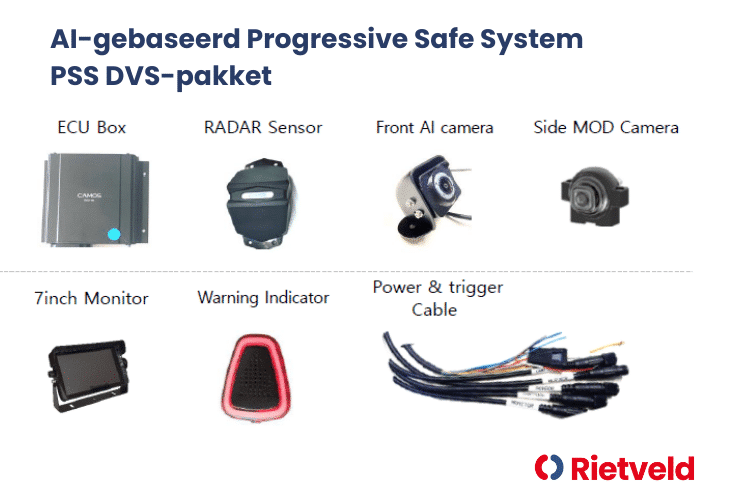
Rietveld supplies a vehicle-specific Progressive Safe System kit from Camos. This solution combines camera footage, intelligent detection, and alerts for the driver and vulnerable road users.
An important component of the kit is the SmartVue DobliCam. This intelligent camera combines visibility and detection in a single unit. The camera monitors critical areas around the vehicle and recognizes road users who are within a preset danger zone.
Depending on the vehicle configuration, the solution consists of:
- camera and monitor views of the blind spot;
- Blind Spot Information System for detection alongside the vehicle;
- Moving Off Information System for detection in front of the vehicle;
- visual warnings for the driver;
- audible warnings in the cab;
- Audible warning on the outside when turning;
- Blind spot warning markings;
- vehicle-specific wiring and mounting components;
- conformity and installation documentation.
The exact configuration must always be tailored to the vehicle and the factory-installed systems already in place.
Blind Spot Information System
The Blind Spot Information System, or BSIS, monitors the critical zone on the side of the truck. Cyclists and pedestrians may be present there without the driver being able to see them directly from the cab.
The system alerts the driver when a vulnerable road user is in the detection zone. If the vehicle begins a turning maneuver and a collision risk arises, the warning becomes more prominent.
By distinguishing between mere presence and actual risk, the driver receives a targeted warning. This helps limit unnecessary alerts and warning overload.
Moving Off Information System
When the vehicle is stationary, a pedestrian or cyclist may be positioned directly in front of the cab. Due to the height and shape of the truck, this person is not always directly visible.
The Moving Off Information System, or MOIS for short, therefore monitors the area in front of the vehicle. The system informs and warns the driver when someone is in this critical zone just as the truck is about to pull away.
This assistance is particularly important at traffic lights, crosswalks, loading areas, and busy city streets.
Not every detection needs to trigger an immediate alarm
A safety system must warn when necessary, without constantly burdening the driver with irrelevant notifications. Too many warnings can be distracting and lead to signals being taken less seriously.
That’s why the detection zones and warnings are tailored to:
- the length and width of the vehicle;
- the position of the cab;
- the body or superstructure;
- the turning radius;
- the location of the cameras;
- everyday traffic conditions;
- left- or right-hand drive configuration.
For Dutch trucks with the steering wheel on the left, cameras, detection systems, and warning devices must be installed around the risk areas relevant to London. Transport for London explicitly states that left-hand-drive foreign trucks must also comply with the DVS requirements.
Does this requirement also apply to existing factory-installed systems?
Newer trucks may already be equipped with cameras and detection systems from the factory. In some cases, these features meet the required safety functions.
Transport for London states that additional camera systems may not be necessary if the vehicle already has equivalent systems that meet relevant UNECE requirements, including BSIS and MOIS.
This does not automatically mean that every modern truck fully meets all PSS requirements. Some components may still be missing, such as:
- an external turn signal;
- the correct warning markings;
- additional camera coverage;
- vehicle-specific documentation;
- proof of the permit application.
Therefore, have a preliminary check conducted to determine what is already in place and what adjustments are still needed. This will help you avoid duplicate systems, redundant warnings, and unnecessary investments.
Installation and documentation are part of compliance
Simply purchasing the right products is not enough. The cameras and detection systems must be mounted in the correct position, set up correctly, and tailored to the vehicle’s dimensions.
Furthermore, when applying for an HGV Safety Permit, you must be able to demonstrate that the necessary measures are in place.
Rietveld therefore supports you throughout the entire process:
- checking the DVS star rating and existing vehicle systems;
- inventory of the required PSS components;
- compiling a vehicle-specific Camos set;
- professional installation and calibration;
- checking functionality and detection zones;
- provision of the available conformity and installation documentation;
- assistance with gathering evidence for the permit application.
This way, you receive not just a technical system, but a complete and verifiable solution.
What are the consequences of driving into London without a permit?
Transport for London monitors vehicles using automatic license plate recognition. A truck driving in the DVS zone without a valid HGV Safety Permit may be fined.
The fine for the vehicle owner or operator can be as high as £550. If paid on time, this amount is usually reduced. In addition, a missing permit can lead to delays, downtime, and disruptions to your schedule.
Therefore, before every trip, check:
- whether the vehicle is subject to the DVS requirement;
- what the vehicle’s star rating is;
- whether the permit is still valid;
- whether the vehicle meets the corresponding PSS requirements;
- whether any changes to the vehicle or license plate have been reported.
Safer Even Outside London
The Camos Progressive Safe System kit was developed to meet the requirements of DVS London, but the safety benefits do not stop at the city limits.
Blind-spot risks also occur in Dutch city centers, at distribution centers, on construction sites, and during loading and unloading. The combination of camera footage and intelligent detection helps drivers everywhere spot vulnerable road users sooner.
This investment therefore supports both compliance and a broader safety policy for your fleet.
Together, we’ll strengthen your fleet
Are your trucks scheduled to travel to London soon? Don’t wait until right before departure to check your DVS status. Our specialists will assess your star rating, existing safety systems, vehicle configuration, and required documentation.
Rietveld supplies, installs, and calibrates the Camos Progressive Safe System kit and helps you prepare your vehicles to be safe and compliant.
Request a DVS inspection or customized advice
Check out the Camos Progressive Safe System kit
Together, skilled, moving forward >
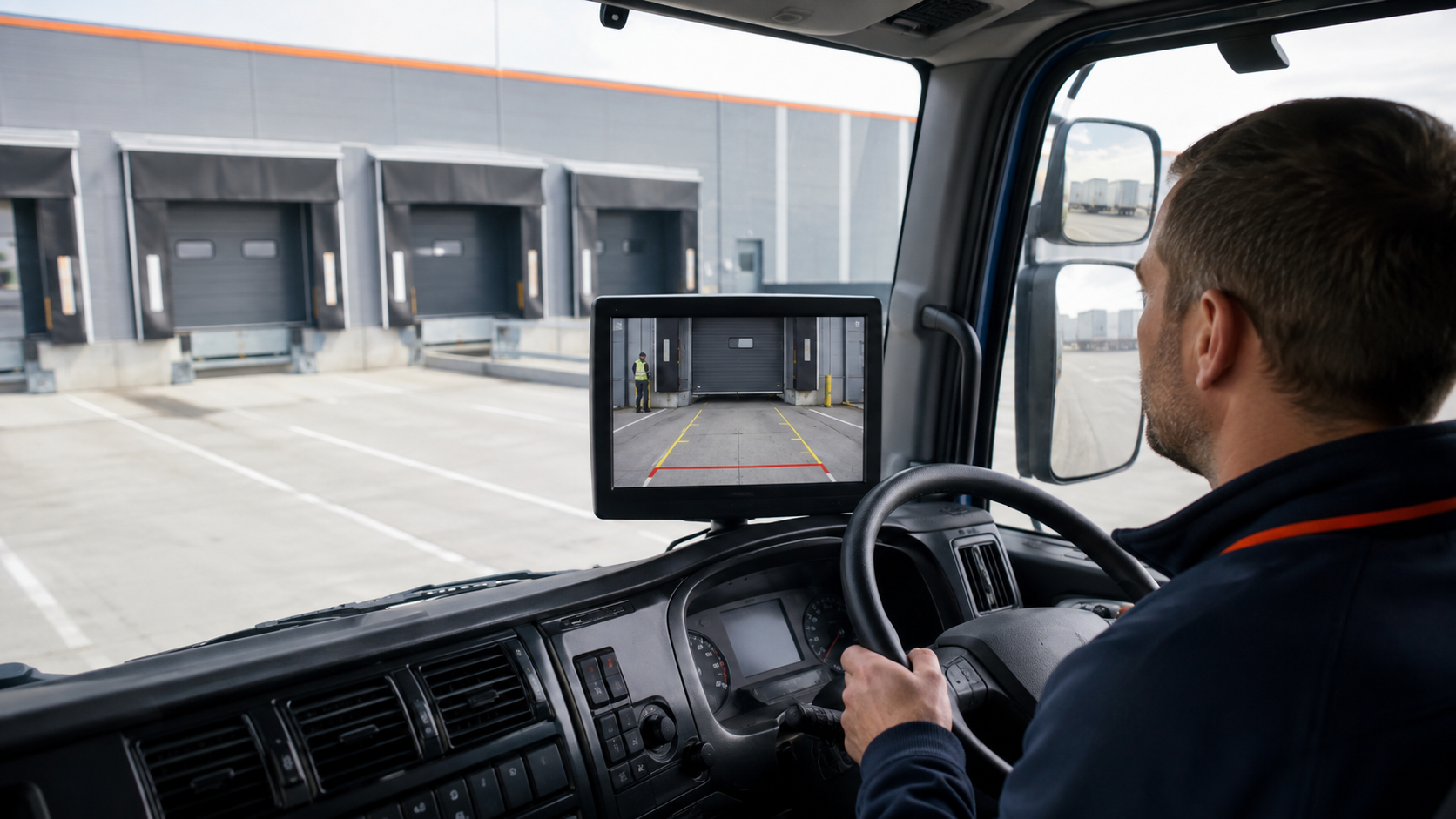
Installing a Rearview Camera for Safe Maneuvering [EN]

Do LED work lights interfere with the radio? Be aware of EMC | Rietveld